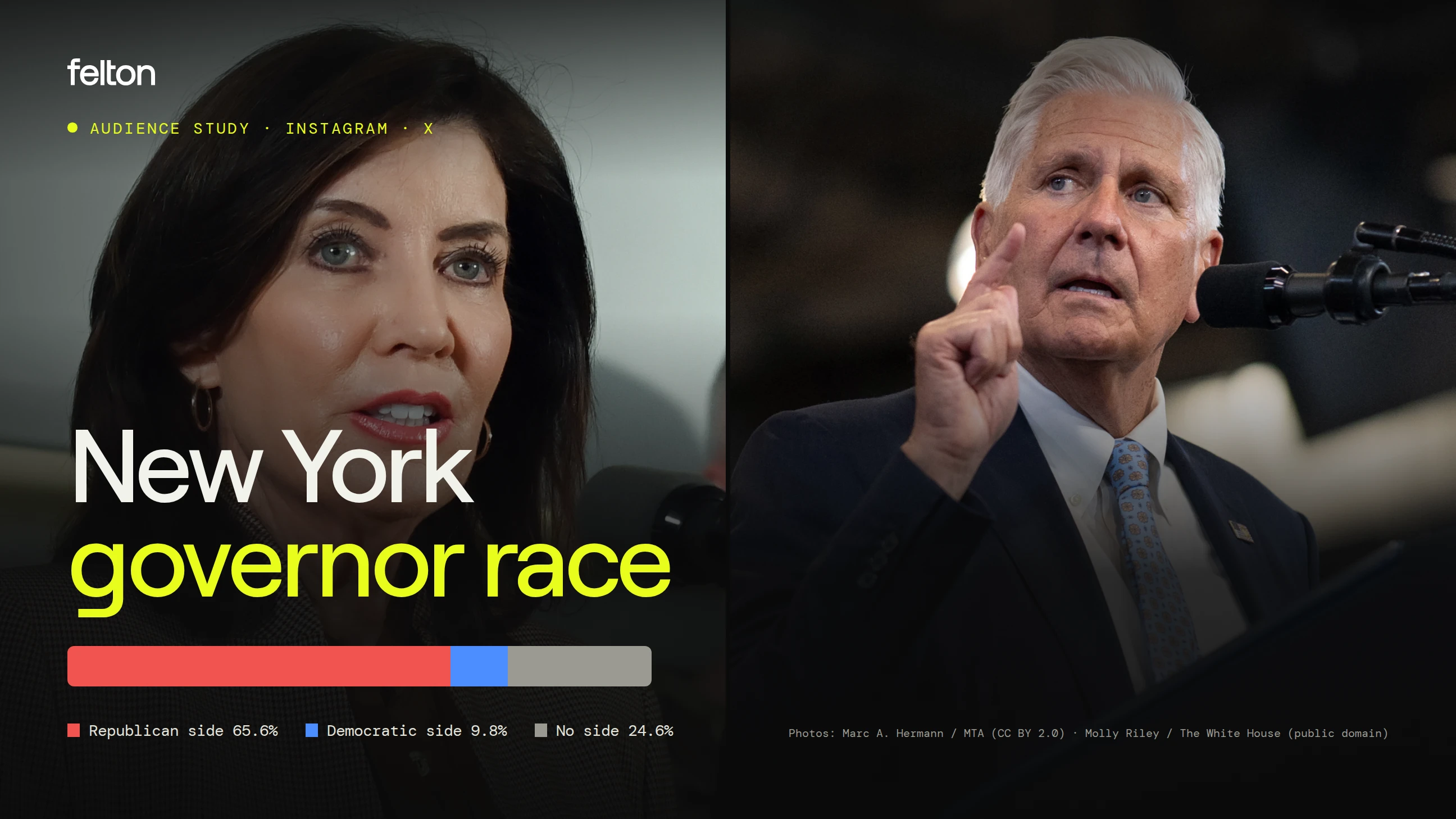

Between September 6 and October 6, 2026, Felton Audiences, the audience intelligence platform from Felton, profiled the 27,509 people who interacted with Kathy Hochul, Bruce Blakeman, their parties and their allies on Instagram and X. Across 12 accounts, 7 on X and 5 on Instagram, the two sides published 806 original posts and received 80,290 comments.
Hochul won re-election on November 3, 2026, defeating Blakeman (CBS News). Between September 6 and October 6, about a month before the vote, most of the people interacting with the race on Instagram and X backed the Republican side, including on Hochul's X, where 77.3% of the comments back her opponent. The people writing in a candidate's comments are not a sample of the people who vote.
This is what audience intelligence shows when it is pointed at a political race: which side each person in the conversation backs, who they are, what they feel and which issues they raise. The study was produced independently and neither campaign commissioned it. It measures the online conversation and does not sample voters. The full study is available as a free download.
The dataset at a glance
The study covers one month of the race on two networks. Hochul is the Democratic candidate and Blakeman the Republican. The accounts in scope belong to the two candidates, their parties and their allies.
The population is the active audience: the people who interacted with those accounts through comments in the period. Each person is counted once per network and only comments with text are read, so totals differ slightly from the platforms' daily counts. Data was extracted on October 8, 2026 at 04:11 EDT.
In the comments, the Republican side outnumbers the Democratic side almost seven to one
Of the 27,509 people in the conversation, 18,051 back the Republican side in their comments (65.6%). 2,686 back the Democratic side (9.8%). The remaining 6,772 show no side (24.6%).
People by side of the race
Share of the 27,509 people in the conversation
- Republican side65.6%
- No side24.6%
- Democratic side9.8%
The imbalance holds on the Democratic side's own pages, where only 6.0% of the comments come from the Democratic side. Negative sentiment runs at 72.4% of all comments: 82.0% on Hochul's side and 60.7% on Blakeman's.
The conversation also moved during the month. On Republican-side pages, the share of comments from the Democratic side went from 11.5% in the first full week to 21.7% in the week of September 27, as the number of Republican-side commenters fell 45%. Only about 2% of the people who commented more than once changed side.
The same candidate draws a different crowd on each network
Of the 33,398 comments on Hochul's X accounts, 77.3% back the Republican side. On her Instagram (10,621 comments) her side reaches 21.0% of the conversation and her opposition share falls to 41.0%.
77.3%
Hochul on X
Share of her comments that back the Republican side
41.0%
Hochul on Instagram
Share of her comments that back the Republican side
Blakeman's numbers run the other way on each network. On his Instagram (22,227 comments), 65.8% back his side and 8.9% back his opponent. On @NassauExec on X, the opposition share rises to 30.7%.
Both candidates draw more opposition on X than on Instagram. For context, in 2025 24% of Republicans reported using X against 19% of Democrats, a reversal from 2023 (Pew Research Center, 2025).
On Instagram, likes add a second reading. On Blakeman's page his supporters write 65.8% of the comments and collect 84.0% of the likes. On Hochul's page the likes are split: her opponents' comments are liked more often (47% against 40%).
Who each side is
The two sides differ in generation, lifestyle and location. The Democratic side is led by Millennials (47.5%), leans cultural and creative and is active mainly on Instagram. The Republican side is led by Gen X (49.5%), leans family-oriented and is active mainly on X.
One pattern runs across both sides. On Instagram, the supporters of each candidate are more female and more Millennial. On X, both sides are more male and more Gen X.
Republicans on X form a different crowd from Republicans on Instagram. Of the Republican-side people on X with an identified state, 46.6% are based in New York State (68.5% on Instagram). Of those with an identified industry, 20.3% work in the military (5.8% on Instagram).
Emotion follows the sides too. Hatred is higher on the Republican side (18.1% of comments against 10.4%). Admiration is higher on the Democratic side (8.6% against 4.3%).
One in four people shows no side
6,772 people, 24.6% of the active audience, show no side in their comments. 85.9% of them commented only once, against 60.2% on the Democratic side and 57.0% on the Republican side. 4,179 of them wrote about a political issue at least once.
Inside New York State this group is younger and more diverse than outside it: 57.5% are Millennials (40.4% outside) and 78.7% are white (88.6% outside). Their comments divide almost evenly between the two candidates' pages.
They agree with posts more often than they disagree on Instagram, for both sides. On X, they disagree more for both. Their share of the conversation peaks on Hochul's 9/11 remembrance, where 84% of the comments came from people with no side, against 5.5% on a typical post.
What each side posts and what the audience raises
Taxes are Blakeman's ground. His side published 173 posts on taxes, 36% of its posts, against 3 from Hochul's side. Hochul's side posted most about affordability (63 posts), Trump (54) and crime and safety (45).
Among the comments that raise a policy issue, the active audience brings up crime and safety most (17.6%), followed by New York City Mayor Zohran Mamdani (14.4%), Trump (12.1%) and taxes (11.8%). Trump is the only issue raised mostly by the Democratic side, which wrote 67.1% of the comments about him.
Issues the active audience raises
Share of the comments that raise a policy issue
- Crime and safety17.6%
- Mamdani14.4%
- Trump12.1%
- Taxes11.8%
Agreement with the posts splits by network. The median Blakeman-side post with 100+ comments drew 73.7% agreement on Instagram and 47.3% on X. For Hochul's side the figures were 21.5% and 1.3%. Her best ground on Instagram was education (34.6% agreement), crime and Trump, each with about a third of the comments agreeing.
Six in a hundred people write a quarter of the comments
1,687 people, 6.1% of the active audience, commented on both candidates' pages on the same network. They wrote 20,235 comments, 25.2% of the total, at about five times the rate of everyone else. 88.0% of them are on the Republican side.
Toxicity concentrates on Hochul's X, where 41.7% of the comments are flagged as toxic, against 21.9% to 22.6% on the candidates' other three pages. By side, the rates are close: 31.3% of the Democratic side's comments and 35.0% of the Republican side's.
What audience intelligence adds for any organization with a large audience
On Hochul's X, a comment count shows a busy page. Audience intelligence shows that three in four of those comments back her opponent and that toxicity there runs at almost twice the level of the candidates' other pages. Across the race, 6% of the people write a quarter of all comments.
Any organization with a large audience on social media faces the same question about its own comments. The people writing there can come largely from outside its base. They differ by network. A small group can write a large share of the conversation. Felton Audiences profiles that active audience on Instagram, TikTok, YouTube and X: who they are, what they feel and which side of a topic they take.
The New York governor race 2026 study is available as a free download on felton.ai.
Header photos: Kathy Hochul by Marc A. Hermann / MTA (CC BY 2.0). Bruce Blakeman by Molly Riley / The White House (public domain).