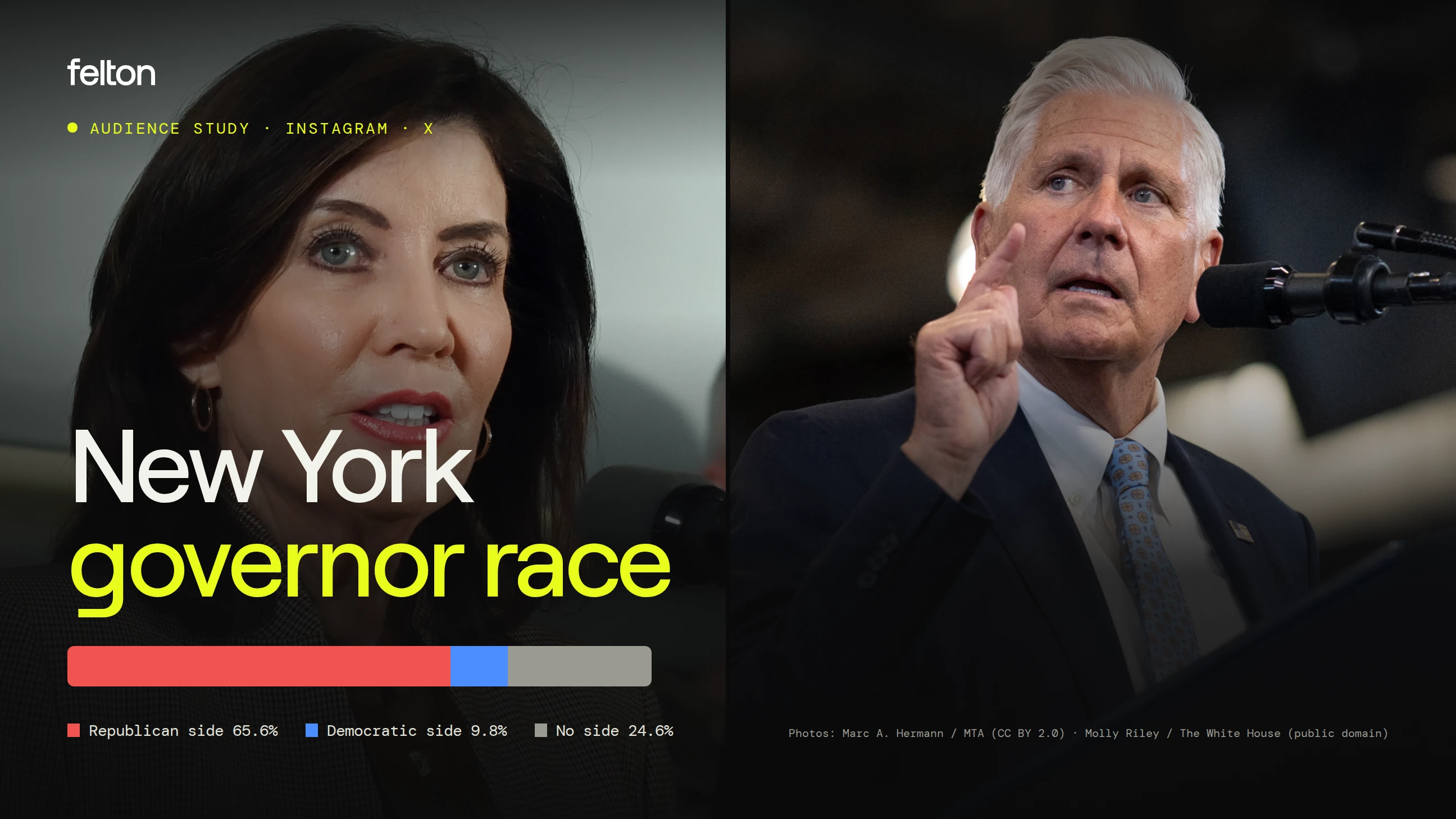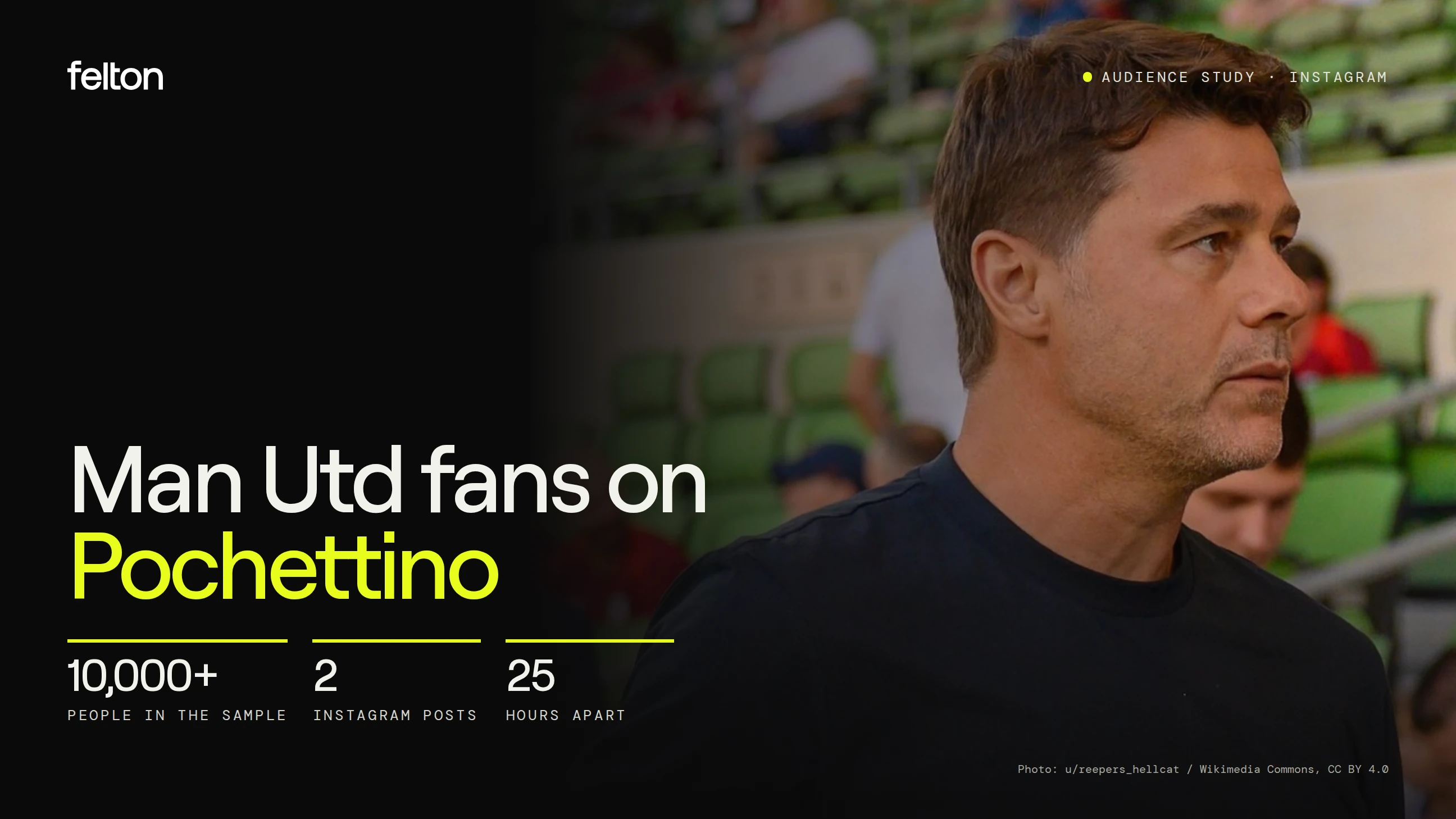

On November 12, 2026, Manchester United announced that Michael Carrick had left his role as head coach. The club was in the relegation zone after its worst start to a league season in 40 years. Carrick was the seventh permanent manager to go since Sir Alex Ferguson retired in 2013 (CNN, Sky Sports). Twenty-five hours later, the club named Mauricio Pochettino (Sky Sports).
Felton Audiences, the audience intelligence platform from Felton, read a sample of about 5,000 comments on each of the two Instagram posts, written by 10,000+ people. On the post announcing Pochettino, the most-liked comment reads "in 8 months." The third reads "I'll be the first to say it: Pochettino was never the problem." It is a line for a sacking that has not happened, written on the day he was hired.
The strongest reaction to the appointment was humour. Humour carries a verdict that a reading in positive and negative cannot hold. This article looks at what the Manchester United study shows when the same reaction is read through emotions, themes and the comments the active audience chose to like.
On tone alone, a farewell and a welcome look alike
Read only by tone, the two posts are close. In the sample, 44.8% of the comments on the exit post are positive and 39.2% negative. On the arrival post the shares are 41.9% and 35.8%. A dashboard with those two bars would describe two similar reactions.
The emotions describe two different events. On the exit post, gratitude (21.9% of the comments with an emotion), sadness (19.3%) and admiration (16%) add up to 57.2%: a farewell. On the arrival post, amusement leads (22.7%), followed by disappointment (14.6%) and frustration (11.8%).
One emotion does not move at all. Frustration is 11.8% on both posts. The anger that was there when Carrick left was still there when Pochettino arrived. Emotion AI separates those layers because it reads 25+ emotions instead of two directions.
The joke was written before the job started
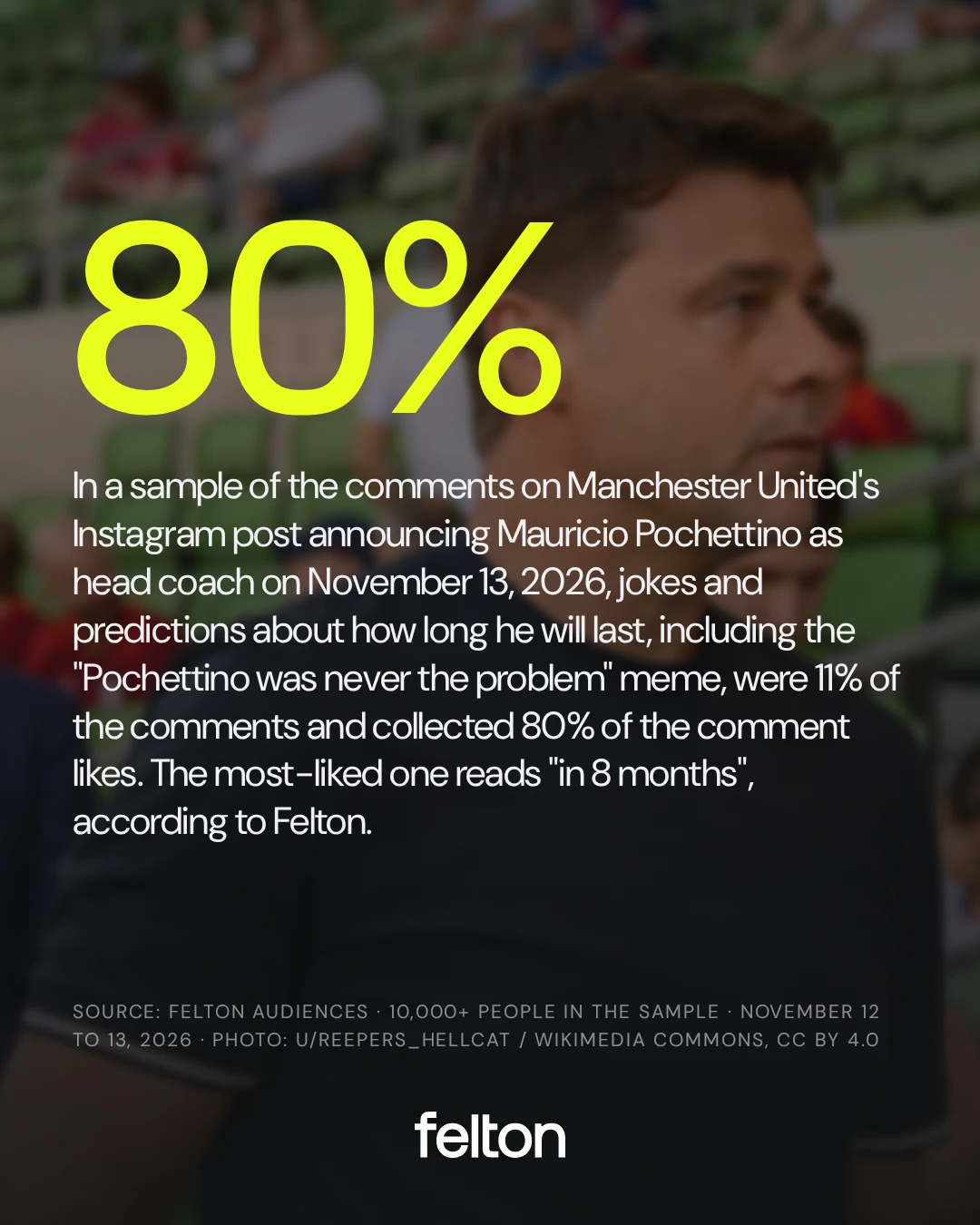
On the arrival post, jokes and predictions about how long Pochettino will last were 11% of the comments in the sample and collected 80% of the comment likes. Five of the ten most-liked comments predict his departure. Three more are versions of "Pochettino was never the problem."
The sharpest one copies the club. On November 12, Manchester United's caption read: "We can confirm Michael Carrick has departed his role as men's first-team head coach." The next day, a comment with 8,703 likes reads: "2027: We can confirm Mauricio Pocchetino has departed his role as men's first-team head coach." Another, with 11,185 likes, imagines the 2027 club statement thanking him for his services.
These jokes need a memory to work. The active audience is reusing the club's own words and the last 13 years of managers to say what it expects. The themes of the comments group them as what they are: predictions about the club, told as jokes.
One phrase changed meaning in 25 hours
"Not the problem" appears on both posts. On the exit post it defends a person against the institution: "Carrick isn't the problem" (6,481 likes). It sits next to the metaphor that collected half of all comment likes on that post: "You cannot fix a broken car by replacing a driver" (30,964 likes).
On the arrival post the same words become a meme about the cycle. "Pochettino was never the problem" (13,252 likes) predicts that the next sacking will be explained the same way.
A count of keywords would put both lines in the same bucket. The likes show what each audience agreed with. Most comments get no likes at all (87% on the exit post and 89% on the arrival post, in the sample) and the ten most-liked comments hold 91% and 88% of all comment likes. The likes are where the verdict is.
What each post wrote and what it liked
Themes of the comments in the sample: share of the comments and share of the comment likes.
Exit post
Michael Carrick, November 12
- Thanks and legacy28.2%23.6%
- The coach is not the problem6.7%62.1%
- Players and the squad6.2%1.2%
- Board and owners3.5%6.3%
- The same cycle2%5.6%
- What Carrick achieved1.5%4.1%
Arrival post
Mauricio Pochettino, November 13
- How long will he last9.6%48%
- Welcome and good luck8.4%28.6%
- The coach is not the problem1.3%33.9%
- Players and the squad3.4%0.1%
- The same cycle3%5.2%
- “Head coach? Not manager?”2.5%2.1%
- Board and owners1.6%0.3%
- Carrick, a day later1.4%0.1%
Laughter lowers the conversation less than anger
The Community Trust Score (CTS) measures the quality of the conversation in the comments, on a scale of 0 to 10. It falls from 5.2 on the exit post to 4.7 on the arrival post. The share of comments with a high score falls from 41.3% to 26.1%.
On the arrival post, comments led by amusement average 5.25, close to the middle of the scale. Comments led by frustration average 2.23 and those led by disappointment 2.40. Hope (7.49) and excitement (8.01) score highest.
There is also a hopeful group. Welcome and good-luck comments are 8.4% of the comments on the arrival post. "Welcome back to the Premier League, Mauricio Pochettino" is the second most-liked comment, with 14,011 likes. Hope and excitement together reach 18.4% of the comments with an emotion.
What a reaction like this asks of the reading
The Pochettino announcement shows four layers that a positive and negative split cannot separate: the emotion that leads (amusement), the emotion that persists (frustration), the theme behind the joke (a prediction about the club) and the comments the active audience chose to like.
The same applies outside football. A new chief executive, a rebrand or a price change can be met with irony. The tone can look balanced while the most-liked comments are already writing the ending.
The Manchester United study is available as a free download on felton.ai.